Learn to read music: a practical starting guide
Reading music brings several skills together. Start by recognising individual notes, then learn to see the relationships between them. These guides and free trainers focus on written pitch in treble clef; you can add rhythm and playing as those positions become familiar.
What slows you down?
- I can’t name the note. Start with how to read treble clef notes, then use the Note Identification Trainer.
- I recognise notes but read one at a time. Learn how to read intervals on sheet music, then try the Sight Reading Interval Trainer.
- I struggle to find thirds and fifths. Work through the example below, then practise with the Major Third & Perfect Fifth Trainer.
1. Find your bearings on the staff
The treble staff has five lines. From bottom to top, the lines are E–G–B–D–F and the spaces are F–A–C–E. G on the second line is a useful reference point. Moving to the next space or line moves one letter through A–B–C–D–E–F–G, then back to A.
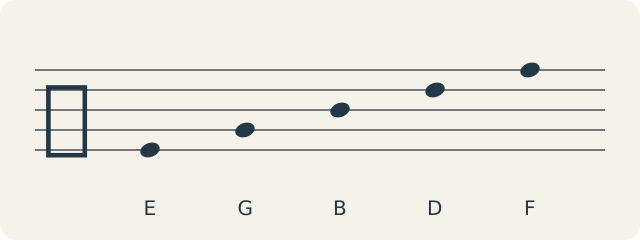
Try it: the second line is G. What is the space immediately above it? It is A. The next line is B.
Read the treble clef guide, then practise naming notes. Begin with ledger lines, sharps and flats switched off; add them when you are comfortable.
2. Read the movement between notes
Once you know where you are, notice whether the next note goes up or down. Count both starting and ending letters to find the interval number: C–D is a second, C–D–E is a third, and C–D–E–F–G is a fifth.
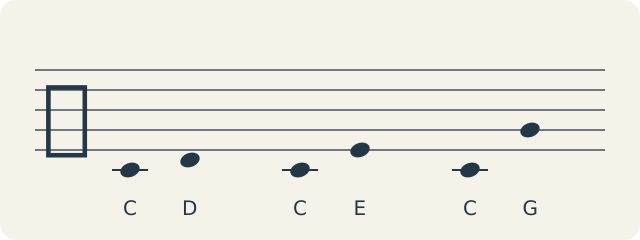
Try it: G up to B spans G–A–B, so it is a third. To name its quality as well, count the semitones: G to B is four semitones, a major third.
Read the written-interval guide, then practise recognising intervals. The trainer uses natural notes from C major and asks for interval quality as well as direction.
3. Find major thirds and perfect fifths
For a major third above C, count three letters including C: C–D–E. C to E is four semitones, so E is the answer. For a perfect fifth above C, count C–D–E–F–G. C to G is seven semitones, so G is the answer.
The letters alone do not guarantee the quality. Above D, the third must be some kind of F, but D to F is only three semitones. Raise F to F♯ to make a major third. A perfect fifth above D is A.
Try it: name the major third and perfect fifth above G. The answers are B and D. Together, G–B–D form a G major triad.
Practise major thirds and perfect fifths. This develops note relationships for harmony; it is a separate exercise from recognising positions on a staff.
Put it together in a short session
- Spend a few minutes naming notes in the note trainer. Read the correction when you miss one.
- Move to the written-interval trainer. Work out direction, number and quality before answering.
- Finish with a few questions in the third and fifth trainer.
- Apply the reading to a short, easy phrase on your instrument or voice. Choose something slow enough to keep going.
There is no required score before you move on. If you are guessing repeatedly, return to the worked examples and reduce the difficulty where settings allow it.
What comes after pitch reading?
Full sight reading also involves rhythm, a steady pulse, articulation and reading ahead while playing or singing. Explore the time signature examples, use the online metronome for a comfortable pulse, and look up unfamiliar terms in the musical dictionary.
These three trainers practise visual recognition and note relationships. They do not test recognising intervals by sound. For listening practice, explore the melodic dictation trainer.