How to read treble clef notes
To read a treble clef note, find its position on the staff, name its letter, then check for any sharp or flat. Start with a few reference notes so you do not have to count from the bottom every time.
This lesson is part of Learn to read music. You can open the Note Identification Trainer whenever you want to practise.
The five lines: E, G, B, D, F
Read the staff from the bottom upward. The bottom line is E, the second line is G, the middle line is B, the fourth line is D and the top line is F.
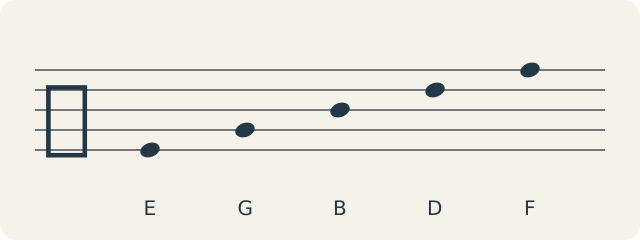
“Every Good Boy Deserves Favour” is one way to remember the order. Use it as a temporary check while learning to recognise each position directly.
The four spaces: F, A, C, E
The spaces between the lines spell FACE from bottom to top. The first space is F, the second is A, the third is C and the fourth is E.
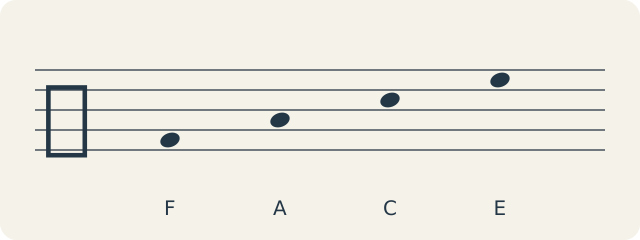
Lines and spaces alternate. From the bottom line upward, the sequence is E–F–G–A–B–C–D–E–F. The centre of the notehead determines the position; the direction of its stem does not change the pitch.
Use landmark notes
Learn G on the second line and C in the third space. From either landmark, move through the musical alphabet to find a nearby note. Above G comes A in the second space, then B on the middle line. Below that G comes F in the first space, then E on the bottom line.
As positions become familiar, try naming the note before checking by counting. Accuracy matters more than rushing.
What about notes outside the staff?
Short extra lines called ledger lines extend the same pattern. Middle C sits on the first ledger line below the treble staff. D is in the space just below the bottom line, and E sits on that bottom line. Above the staff, G occupies the space above the top line and A sits on the first ledger line above it.
Do not restart the alphabet at a ledger line: keep moving through A–B–C–D–E–F–G.
Sharps and flats keep the letter name
A sharp raises a pitch by one semitone; a flat lowers it by one semitone. A note on the second line remains a kind of G: G♯ with a sharp, G♭ with a flat. A natural sign cancels a sharp or flat.
In a piece, also check the key signature and earlier accidentals in the bar. A key signature applies to the named notes across octaves; an accidental normally applies to that note at the same octave for the rest of the bar.
A quick reading check
Name these positions before reading the answers:
- The second line from the bottom.
- The third space from the bottom.
- The middle line.
- The space immediately above the second line.
- The first ledger line below the staff.
Answers: 1. G. 2. C. 3. B. 4. A. 5. Middle C.
If a position was difficult, find the nearest landmark and trace the intervening letters once. Then try recognising the position again without counting.
Practise the notes, then connect them
Open the free Note Identification Trainer. Start with natural notes and ledger lines switched off. After each answer, check the feedback. Use the accuracy list to see which positions need attention, and add ledger lines or accidentals when you want a broader range.
This trainer currently uses treble clef. Bass clef places the letters differently, so these line and space names do not transfer directly.
When individual notes feel familiar, continue with how to read intervals on sheet music. Recognising the relationship between notes helps you read a phrase as connected movement. Return to the music-reading learning path for the full sequence.