How to read intervals on sheet music
To read an interval on sheet music, check three things: whether the notes move up or down, how many letter names they span, and how many semitones separate them. Those give you direction, interval number and quality.
This lesson is part of Learn to read music. If finding the starting note is difficult, begin with how to read treble clef notes.
1. Notice the direction
For two successive notes on the same staff, a higher second note means upward movement and a lower second note means downward movement. Read the noteheads, not the stems. Accidentals affect the precise pitch, which you will check when naming the quality.
2. Count both ends
Count letters inclusively. C up to E spans C–D–E: three letters, so it is a third. C up to G spans C–D–E–F–G: five letters, so it is a fifth. E down to C is also a third, counted E–D–C.
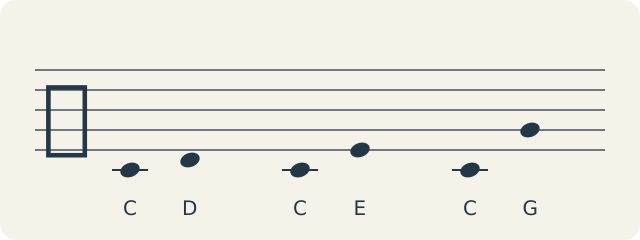
For different staff positions, these visual checks help:
- A second moves from a line to the adjacent space, or from a space to the adjacent line.
- A third moves from one line to the next line, or from one space to the next space.
- A fifth moves two lines upward or downward, or two spaces, passing over one intervening line or space of the same kind.
Odd-numbered intervals connect line to line or space to space. Even-numbered intervals connect line to space. This is a check on the number, not enough information to name the quality.
3. Check the quality
Two thirds can have different sizes. C to E is four semitones: a major third. D to F is three semitones: a minor third. Both span three letter names, but they sound different and have different qualities.
| Interval | Semitones | Ascending example |
|---|---|---|
| Minor second | 1 | E–F |
| Major second | 2 | C–D |
| Minor third | 3 | D–F |
| Major third | 4 | C–E |
| Perfect fourth | 5 | C–F |
| Augmented fourth | 6 | F–B |
| Diminished fifth | 6 | B–F |
| Perfect fifth | 7 | C–G |
| Minor sixth | 8 | E–C |
| Major sixth | 9 | C–A |
| Minor seventh | 10 | D–C |
| Major seventh | 11 | C–B |
| Perfect octave | 12 | C–C above |
The examples all ascend to the next named note within an octave. On a keyboard, each move to the next key, black or white, is one semitone. E–F and B–C are one semitone apart; the other neighbouring natural letters are two semitones apart.
Letter spelling still matters. F up to B spans four letters, so its six semitones form an augmented fourth. B up to F spans five letters, so the same semitone distance forms a diminished fifth. Do not use semitone count alone to choose between them.
Work through an example: G up to B
- B sits above G, so the direction is up.
- G–A–B spans three letters, so the number is a third.
- G to A is two semitones and A to B is another two: four altogether.
- The answer is an ascending major third.
For B down to G, reverse the direction. The distance is still four semitones across three letters: a descending major third.
Check yourself
Name the direction, number and quality. Assume natural notes, with each second note within one octave of the first.
- C up to E.
- E up to F.
- G down to C.
- B up to F.
Answers: 1. Ascending major third. 2. Ascending minor second. 3. Descending perfect fifth. 4. Ascending diminished fifth.
If you missed the number, count both endpoint letters. If you missed the quality, check semitones and any accidentals separately.
Practise reading written intervals
Use the Sight Reading Interval Trainer to identify pairs of notes on a treble staff. It uses natural notes from C major, including major, minor, perfect and tritone examples in both directions. Even without sharps and flats, the intervals are not all major or perfect.
For a different exercise, use the Major Third & Perfect Fifth Trainer to recall the upper note of a specified interval. For help recognising the individual positions, return to the Note Identification Trainer.
Written-interval practice develops one part of sight reading. Also practise rhythm and reading an easy phrase continuously on your instrument or voice. The trainer does not play interval sounds; recognising intervals by ear is a separate skill. Follow the music-reading learning path to combine these exercises.